


Customer expectations have changed dramatically. In today’s always-on digital economy, businesses are expected to deliver instant, accurate, and personalized support across multiple channels. Traditional support tools and manual helpdesk systems are struggling to keep up. This is why intelligent virtual assistants (IVAs) are rapidly replacing legacy support solutions across B2B organizations.
Powered by AI and natural language processing, intelligent virtual assistants are transforming customer and employee support into a scalable, efficient, and experience-driven function.
What Are Intelligent Virtual Assistants?
Intelligent virtual assistants are AI-driven systems that understand, process, and respond to human language in real time. Unlike traditional rule-based chatbots, IVAs use machine learning, NLP, and contextual awareness to deliver more accurate and conversational interactions.
They continuously learn from interactions, improving responses and adapting to user needs over time.
Why Traditional Support Tools Are Falling Short
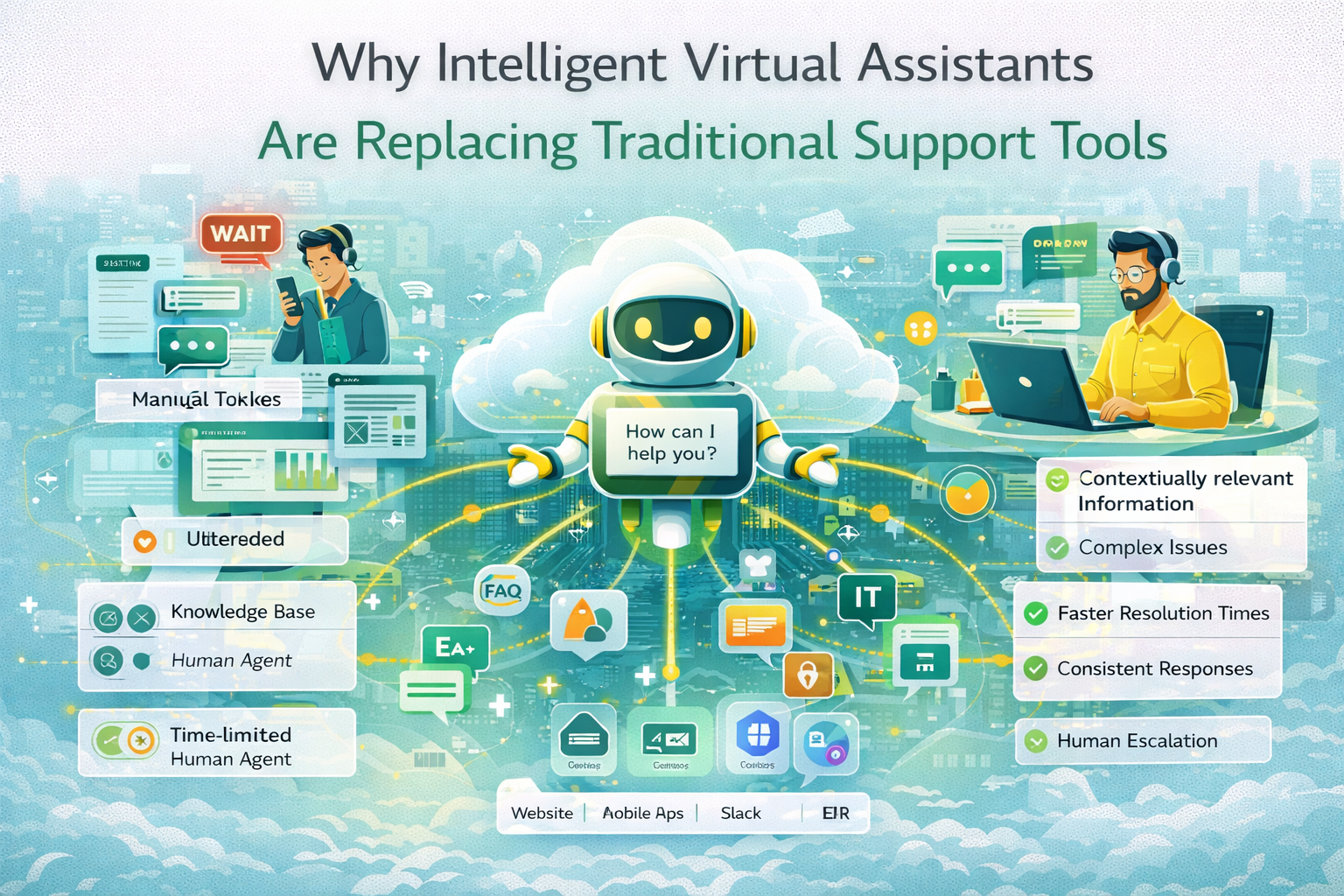
Traditional support tools often rely on:
- Manual ticket handling
- Static knowledge bases
- Limited availability and slow response times
- High dependency on human agents
As support volumes grow, these systems become expensive, slow, and difficult to scale — leading to poor customer experiences and higher operational costs.
Key Benefits of Intelligent Virtual Assistants for B2B Organizations
1. 24/7 Instant Support
IVAs provide round-the-clock assistance, ensuring customers and employees receive immediate responses without delays.
2. Reduced Support Costs
By automating repetitive queries, intelligent virtual assistants significantly reduce ticket volumes and support staffing costs.
3. Faster Resolution Times
IVAs instantly retrieve relevant information and resolve issues in seconds, improving overall service efficiency.
4. Consistent and Accurate Responses
AI-driven assistants ensure standardized, accurate answers across all support channels.
5. Seamless Escalation to Human Agents
Complex issues are intelligently routed to human agents with full context, improving resolution quality and speed.
How Intelligent Virtual Assistants Are Transforming B2B Support
Customer Support Automation
IVAs handle common queries such as onboarding, billing, order status, and product usage — freeing human agents for higher-value interactions.
Internal IT and HR Support
Virtual assistants support employees with IT troubleshooting, policy queries, and HR requests, improving internal productivity.
Omnichannel Engagement
IVAs integrate seamlessly across websites, mobile apps, messaging platforms, and enterprise tools like Slack and Microsoft Teams.
Data-Driven Insights
Every interaction generates valuable insights that help organizations improve products, services, and customer experiences.
Security and Compliance Advantages
Modern intelligent virtual assistants are designed with enterprise-grade security, including:
- Data encryption
- Role-based access controls
- Compliance with industry regulations
This makes them suitable for regulated B2B industries such as finance, healthcare, and enterprise SaaS.
Intelligent Virtual Assistants and Digital Transformation
IVAs play a critical role in digital transformation strategies by modernizing support operations and enabling scalable, AI-driven engagement.
By combining automation with personalization, businesses can deliver exceptional experiences while maintaining cost efficiency.
Who Should Adopt Intelligent Virtual Assistants?
Intelligent virtual assistants are ideal for:
- B2B SaaS companies
- Enterprises with high support volumes
- IT service and operations teams
- Organizations focused on customer experience optimization
Any business looking to scale support without sacrificing quality can benefit.
The Future of B2B Support Is Intelligent
As AI technology continues to advance, intelligent virtual assistants will become even more conversational, predictive, and proactive. Organizations that adopt IVAs early will gain a strong advantage through faster support, lower costs, and higher customer satisfaction.
Conclusion
Intelligent virtual assistants are redefining how B2B organizations deliver support. By replacing traditional tools with AI-powered, scalable solutions, businesses can improve efficiency, reduce costs, and elevate the support experience.
In a world where speed and personalization matter, intelligent virtual assistants are no longer optional — they are essential.