


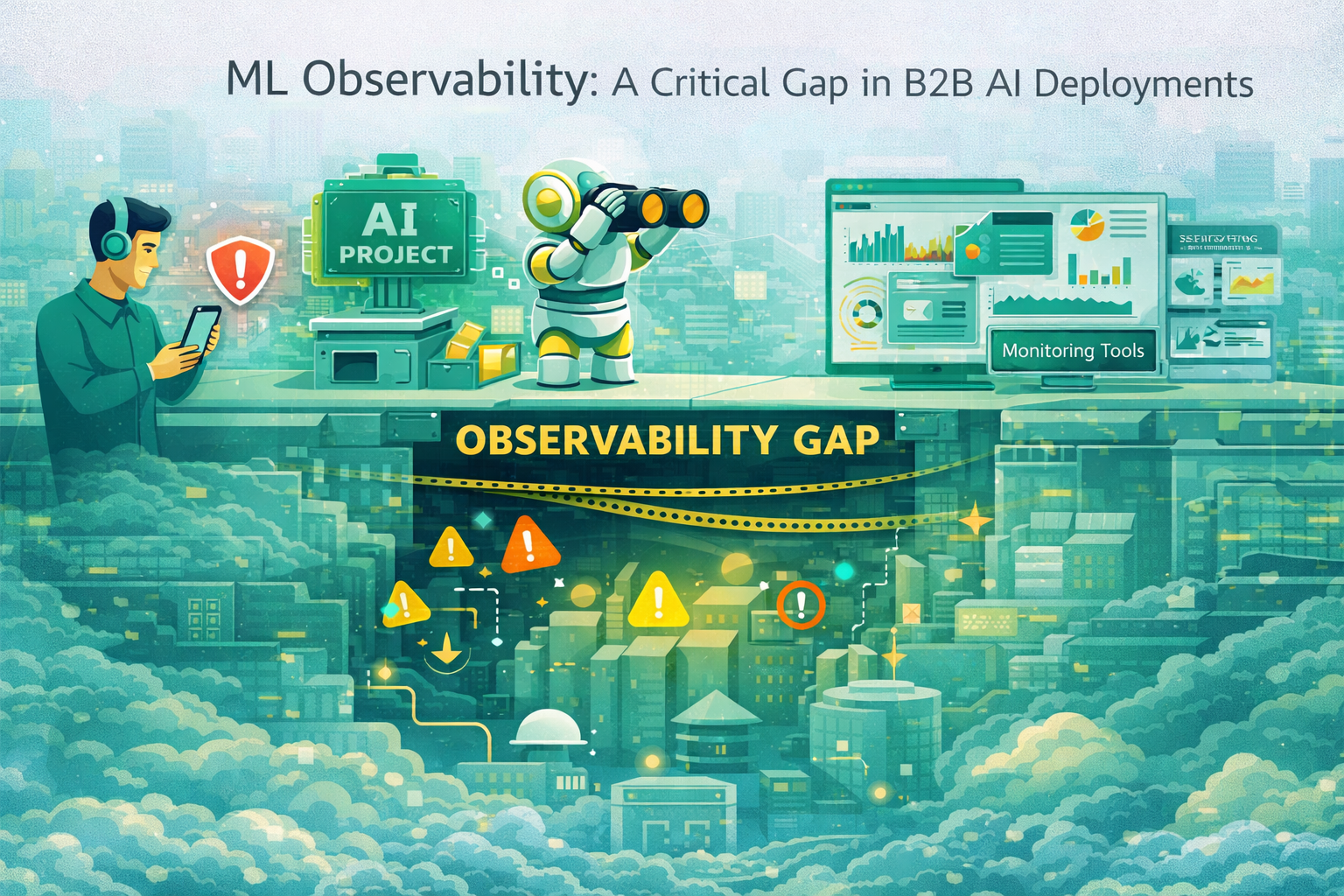
As B2B organizations increasingly adopt artificial intelligence and machine learning to drive smarter decisions, many face an unexpected challenge after deployment — lack of visibility into how ML models perform in real-world environments. This challenge is known as the ML observability gap, and it has become a critical barrier to scaling AI successfully.
Without proper ML observability, even the most advanced AI models can silently degrade, introduce risk, and undermine business outcomes.
What Is ML Observability?
ML observability refers to the ability to monitor, measure, and understand the behavior and performance of machine learning models in production. It goes beyond traditional system monitoring by tracking:
- Data quality and drift
- Model accuracy and bias
- Prediction performance
- Feature behavior and anomalies
ML observability ensures AI systems remain reliable, fair, and aligned with business objectives over time.
Why ML Observability Matters for B2B AI Deployments
B2B AI systems often support mission-critical functions such as fraud detection, demand forecasting, personalization, and risk assessment. When models fail or degrade without detection, the business impact can be severe.
ML observability helps organizations:
- Detect model performance issues early
- Prevent inaccurate or biased predictions
- Maintain regulatory and compliance standards
- Build trust in AI-driven decisions
Without observability, AI becomes a black box — risky, unpredictable, and difficult to scale.
The Business Risks of Poor ML Observability
Organizations lacking ML observability may face:
- Undetected model drift impacting decision accuracy
- Data quality issues leading to flawed predictions
- Compliance and governance challenges
- Reduced confidence from stakeholders and customers
These risks directly affect revenue, operational efficiency, and brand credibility.
Key Benefits of ML Observability for B2B Organizations
1. Consistent Model Performance
Continuous monitoring ensures models deliver accurate and reliable outcomes even as data patterns change.
2. Faster Issue Detection and Resolution
Early alerts enable teams to identify anomalies, retrain models, or roll back changes before issues escalate.
3. Improved AI Governance and Compliance
ML observability supports explainability, auditability, and responsible AI practices — essential for regulated industries.
4. Increased ROI on AI Investments
By ensuring models perform as expected, organizations maximize the business value of their AI initiatives.
5. Greater Trust in AI Systems
Transparent model performance builds confidence among internal teams, partners, and customers.
How ML Observability Strengthens B2B AI Deployments
Monitoring Data Drift and Quality
ML observability tools track changes in input data, ensuring models are not making decisions based on outdated or corrupted data.
Tracking Model Accuracy in Production
Continuous evaluation ensures predictions remain aligned with real-world outcomes.
Detecting Bias and Anomalies
Observability enables proactive identification of bias, fairness issues, and unexpected behavior.
Aligning AI with Business KPIs
Performance metrics are tied directly to business outcomes, ensuring AI supports strategic goals.
ML Observability and Enterprise AI Maturity
ML observability is a key indicator of enterprise AI maturity. Organizations that treat observability as a core capability can:
- Scale AI deployments confidently
- Reduce operational and compliance risks
- Accelerate AI-driven innovation
As AI adoption grows, observability becomes a foundational requirement rather than an optional add-on.
Who Should Prioritize ML Observability?
ML observability is essential for:
- B2B enterprises deploying AI at scale
- SaaS platforms offering AI-powered features
- Financial services, healthcare, and regulated industries
- Organizations focused on responsible AI
Any business running AI in production needs ML observability to ensure long-term success.
Closing the ML Observability Gap
As AI systems become more complex, the gap between model deployment and real-world performance continues to widen. Closing this gap with robust ML observability is critical for building reliable, ethical, and scalable AI solutions.
Conclusion
ML observability addresses one of the most overlooked challenges in B2B AI deployments. By providing continuous visibility into model behavior, data quality, and performance, organizations can mitigate risk, improve outcomes, and unlock the full potential of AI.
For B2B companies investing in AI, ML observability is not just a technical requirement — it’s a strategic necessity.