

In today’s competitive SaaS ecosystem, VoIP providers are under constant pressure to not just generate leads—but to build a qualified, predictable pipeline that converts into revenue.
Relying on a single channel is no longer effective. Modern IT buyers engage across multiple touchpoints before making a decision. That’s why multi-channel B2B campaigns have become essential for driving high-quality pipeline.
This blog explores how VoIP companies can leverage a multi-channel approach to attract, engage, and convert the right audience.
Why Multi-Channel Campaigns Are Critical for VoIP Growth
IT decision-makers don’t follow a linear buying journey. They:
- Research solutions on search engines
- Engage with content across platforms
- Compare vendors before initiating contact
A multi-channel strategy ensures your brand remains visible and relevant throughout this journey.
Key benefits:
- Increased brand recall
- Higher engagement rates
- Better lead qualification
- Stronger pipeline consistency
1. Start with a Defined Ideal Customer Profile (ICP)
A successful campaign begins with clarity on who you are targeting.
For VoIP providers, an ideal customer profile may include:
- Mid-to-large enterprises with distributed teams
- Industries like BFSI, healthcare, or IT services
- Roles such as CIOs, IT Directors, and Network Managers
Defining your ICP ensures every channel and message is aligned with the right audience.
2. Combine SEO and Content Marketing for Inbound Demand
Search-driven content plays a crucial role in capturing high-intent traffic.
Focus on creating SEO-optimized content around:
- “Best VoIP solutions for enterprises”
- “Cloud telephony benefits for remote teams”
- “VoIP vs PBX comparison”
Content formats that drive pipeline:
- Long-form blogs
- Solution guides
- Technical whitepapers
- Case studies with measurable results
High-quality content attracts prospects who are already researching solutions—making them more likely to convert.
3. Amplify Reach with Content Syndication
Content syndication helps extend your reach beyond owned channels.
By distributing assets like:
- Whitepapers
- eBooks
- Industry reports
—you can engage with pre-qualified IT audiences across trusted platforms.
This channel is particularly effective for:
- Generating marketing-qualified leads (MQLs)
- Expanding reach into new markets
- Targeting specific industries and job roles
4. Use LinkedIn for Precision Targeting
LinkedIn remains one of the most effective platforms for B2B campaigns.
With advanced targeting options, you can reach:
- Specific job titles (CIO, IT Head, CTO)
- Industries and company sizes
- Decision-makers within target accounts
High-performing LinkedIn tactics:
- Sponsored content promoting thought leadership
- Lead generation forms for gated assets
- Conversation ads for direct engagement
This ensures your messaging reaches the right people with high relevance.
5. Integrate Email Marketing for Lead Nurturing
Email remains a powerful channel for nurturing prospects across the funnel.
A well-structured email strategy should:
- Deliver value-driven content
- Guide prospects through the buyer journey
- Address common pain points and objections
Example email flow:
- Awareness: Educational insights
- Consideration: Case studies and comparisons
- Decision: Demo offers and ROI-focused messaging
Consistency in communication builds trust and keeps your brand top-of-mind.
6. Retarget High-Intent Visitors Across Channels
Most prospects won’t convert on their first interaction.
Retargeting allows you to re-engage users who:
- Visited your website
- Downloaded content
- Engaged with ads
Use retargeting to:
- Promote deeper content (webinars, demos)
- Reinforce value propositions
- Move prospects closer to conversion
7. Align Sales and Marketing for Pipeline Acceleration
A multi-channel campaign is only effective when sales and marketing are aligned.
This includes:
- Sharing insights on lead behavior and intent
- Coordinating follow-ups based on engagement signals
- Personalizing outreach using campaign data
When both teams work together, lead quality improves and conversion rates increase.
8. Track Performance Across Channels
To optimize your campaigns, focus on metrics that directly impact pipeline growth:
- Cost per qualified lead (CPL)
- Conversion rates by channel
- Pipeline contribution
- Lead-to-opportunity ratio
Analyzing performance across channels helps identify what’s working and where to invest more.
Conclusion
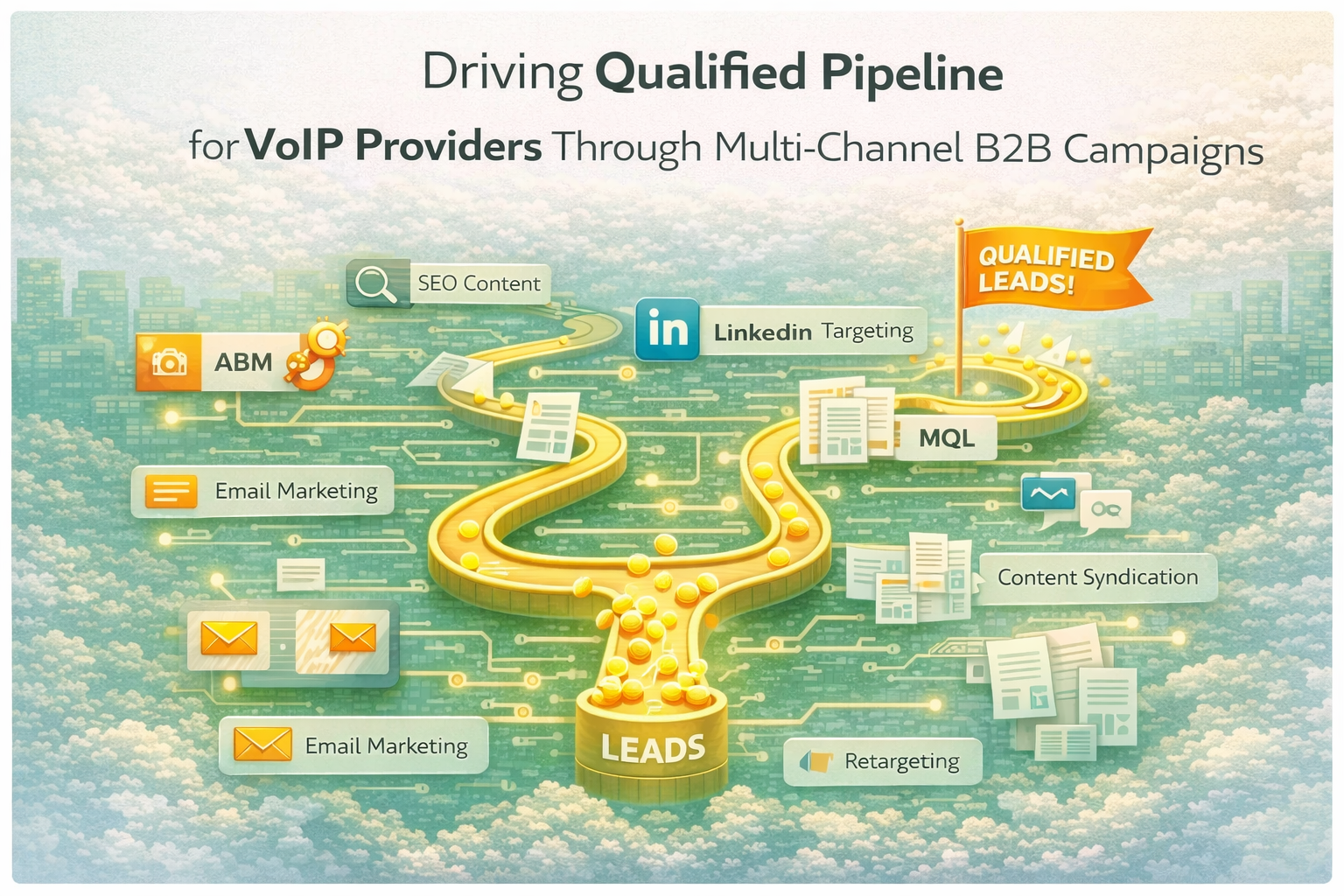
Driving a qualified pipeline in the VoIP space requires a cohesive, multi-channel strategy that meets IT decision-makers at every stage of their journey.
By combining:
- SEO and content marketing
- Content syndication
- LinkedIn targeting
- Email nurturing
- Retargeting
VoIP providers can build a scalable pipeline filled with high-intent prospects.
The key is not just being present across channels—but delivering consistent, relevant, and value-driven messaging at every touchpoint.