


Introduction
In today’s data-driven B2B landscape, marketing success is no longer measured by activity alone—it’s defined by impact on revenue, pipeline, and growth. For Chief Marketing Officers (CMOs), tracking the right metrics is critical to making informed decisions and demonstrating marketing’s contribution to business outcomes.
With evolving buyer behavior and increasing pressure for accountability, CMOs must focus on metrics that go beyond surface-level performance. As a B2B media house working closely with marketing leaders, we’ve seen how the right measurement framework can transform demand generation into a predictable and scalable growth engine.
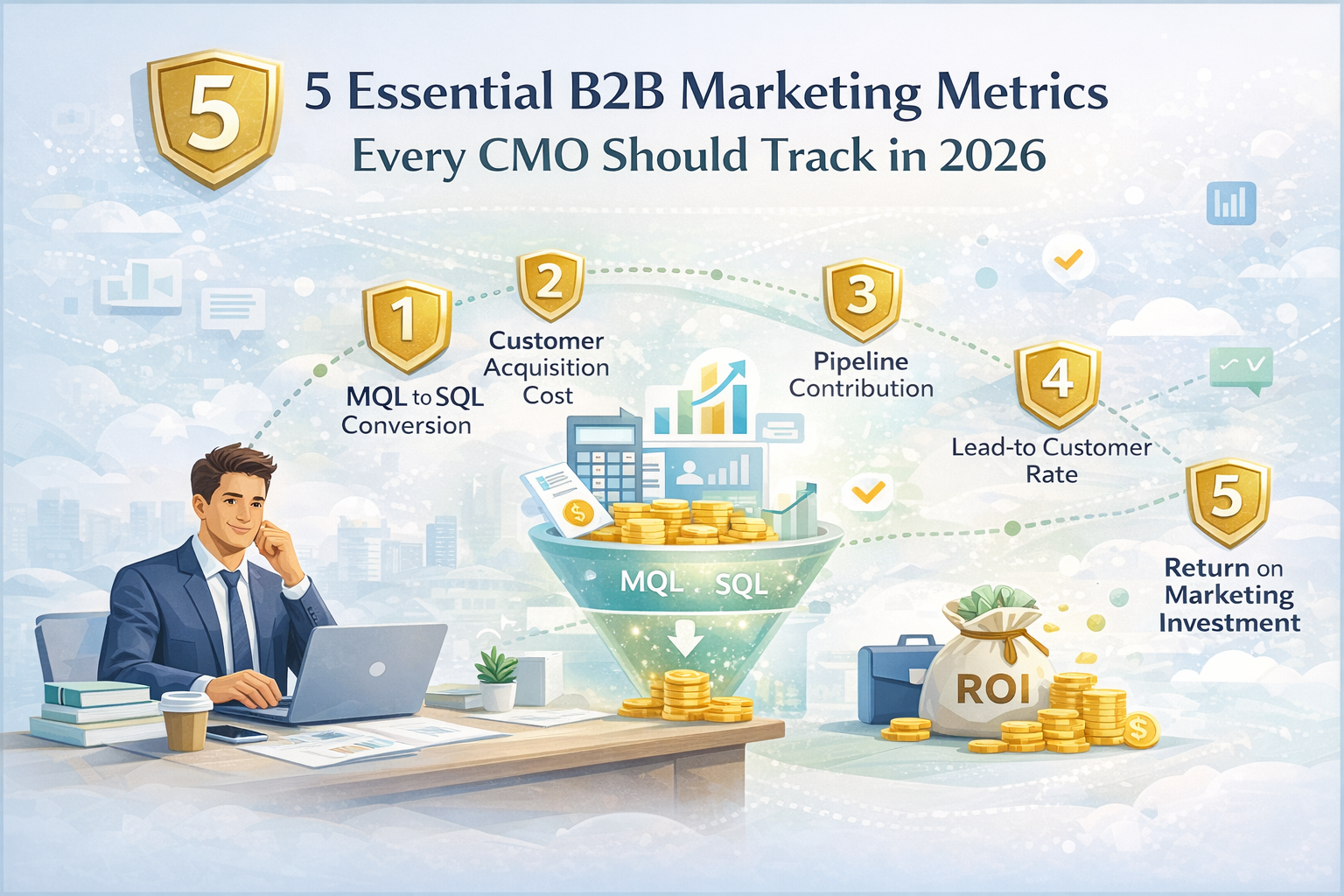
In this blog, we explore the five essential B2B marketing metrics every CMO should track in 2026.
1. Marketing Qualified Leads (MQLs) to Sales Qualified Leads (SQLs) Conversion Rate
One of the most critical indicators of marketing effectiveness is how well leads progress through the funnel.
Why It Matters:
- Reflects lead quality and targeting accuracy
- Indicates alignment between marketing and sales
- Helps identify gaps in lead nurturing
A strong MQL to SQL conversion rate shows that marketing efforts are generating relevant and high-intent prospects, not just volume.
2. Customer Acquisition Cost (CAC)
Customer Acquisition Cost measures the total investment required to acquire a new customer.
Why It Matters:
- Provides visibility into marketing efficiency
- Helps optimize budget allocation
- Ensures sustainable growth
For CMOs, maintaining a balanced CAC is essential to ensure that marketing efforts are cost-effective and scalable.
3. Pipeline Contribution from Marketing
This metric tracks how much of the sales pipeline is generated through marketing efforts.
Why It Matters:
- Directly links marketing to revenue generation
- Demonstrates the impact of campaigns
- Helps prioritize high-performing channels
As a B2B media house, we emphasize pipeline contribution as a key metric for evaluating true marketing performance.
4. Lead-to-Customer Conversion Rate
This metric measures how effectively leads are converted into paying customers.
Why It Matters:
- Indicates overall funnel efficiency
- Highlights the quality of generated leads
- Helps refine targeting and messaging
A higher conversion rate suggests that marketing is successfully attracting prospects with strong buying intent.
5. Return on Marketing Investment (ROMI)
ROMI evaluates the revenue generated from marketing activities relative to the investment made.
Why It Matters:
- Provides a clear view of marketing ROI
- Helps justify budget decisions
- Supports data-driven strategy optimization
For CMOs, ROMI is essential for demonstrating how marketing contributes to business growth and profitability.
Moving Beyond Vanity Metrics
While metrics like impressions, clicks, and website traffic are useful, they do not provide a complete picture of performance.
Modern B2B marketing requires a shift toward:
- Revenue-focused measurement
- Intent-driven engagement tracking
- Pipeline and conversion-based insights
This ensures that marketing efforts are aligned with business outcomes, not just activity levels.
Aligning Metrics with Strategy
Tracking the right metrics is only effective when aligned with a clear strategy.
For CMOs, this means:
- Defining measurable goals across the funnel
- Aligning marketing and sales around shared KPIs
- Leveraging data to continuously optimize campaigns
- Focusing on long-term growth, not short-term wins
As a B2B media house, we help organizations build data-driven marketing frameworks that deliver consistent and measurable results.
Building a Data-Driven Marketing Organization
To fully leverage these metrics, organizations must:
- Invest in the right analytics and reporting tools
- Ensure data accuracy and integration across systems
- Foster collaboration between teams
- Continuously refine measurement approaches
This enables CMOs to make informed decisions and drive strategic growth.
Conclusion
In 2026, the role of a CMO is increasingly tied to measurable business outcomes. Tracking the right B2B marketing metrics—such as MQL to SQL conversion, CAC, pipeline contribution, lead-to-customer conversion, and ROMI—is essential for building a predictable and high-performing marketing function.
As a B2B media house, we enable marketing leaders to go beyond traditional metrics and focus on what truly matters—driving high-intent leads, accelerating pipeline growth, and delivering measurable ROI.